Enterprise fiber Internet in Kentucky and Southern Illinois
Quad State Internet designs and delivers dedicated Internet, private transport, routing, fiber infrastructure, and interconnection for organizations whose network path must be documented, supportable, and ready to grow.
Start with the locations, then shape the network.
Place a business site or define endpoints for Internet, transport, wavelength, dark fiber, and interconnection review.
Enterprise connectivity services
Start with the kind of network outcome you need. Each service page explains the topology, handoff, capacity, routing, protection, acceptance, and support details that should be settled before an order is approved.
Internet and routing
Dedicated Internet, transit, routing control, and readiness for Internet-facing risk.
Private transport
Private paths between facilities, applications, interconnection points, and cloud-adjacent handoffs.
Fiber infrastructure
Dark fiber, long-term route rights, customer laterals, entrances, and purpose-built last mile access.
Facilities and interconnection
Colocation, carrier handoffs, cross-connects, exchange access, and wholesale delivery.
Resilience and planning
Dependency review, recovery paths, route planning, and a documented design before circuits are ordered.
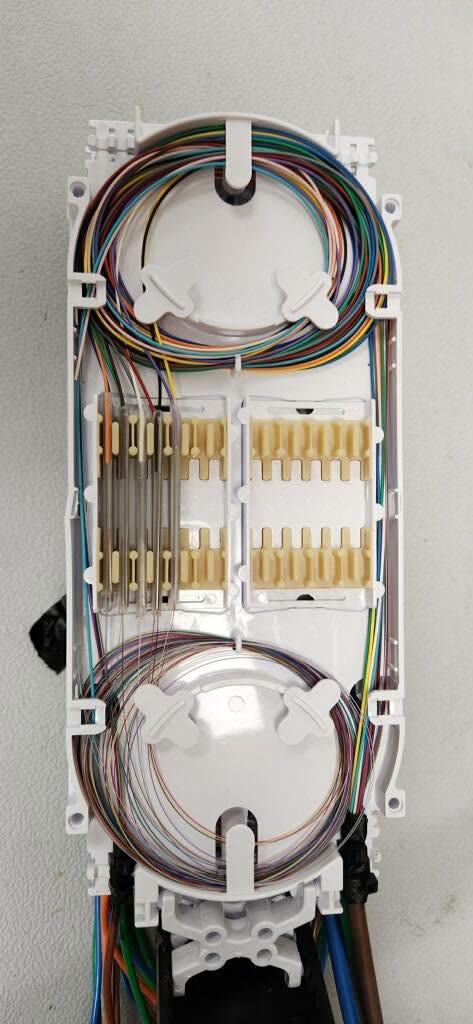
A route is only useful when the field work remains supportable.
Clean fiber organization, documented access, measurable handoffs, and technicians who can return to the physical network are part of the enterprise design, not an afterthought.
Enterprise fiber connectivity that maps to the business problem
A buyer may search for enterprise Internet provider, dedicated fiber Internet, metro Ethernet, ISP transport provider, carrier-neutral colocation, or redundant Internet. The real question is what the network has to accomplish. Quad State Internet scopes the service around locations, traffic, routing, resilience, timeline, and support instead of forcing every request into one circuit type.
What a decision-ready design should show
A useful enterprise proposal is more than a speed and monthly price. It should make the physical path, network behavior, measurable objectives, ownership boundaries, and operating process clear enough for engineering, procurement, and support teams to review together.
Technical scope
- Endpoints and demarcationExact facilities, entrances, cabinets, panels, ports, media, optics, and customer/provider equipment boundaries.
- Capacity and traffic profileCommitted bandwidth, interface speed, symmetry or burst terms where applicable, MTU/VLAN needs, and growth triggers.
- Addressing and routingIPv4/IPv6, static or dynamic routing, ASN and BGP policy, prefixes, filters, communities, and failover behavior.
- Protection versus diversityWhich entrances, laterals, outside plant, devices, power, carriers, upstreams, and facilities are actually independent.
Operating scope
- Service objectivesAvailability, delay, loss, jitter, response, and repair objectives only where they apply, including measurement points and exclusions.
- Delivery and acceptanceSite readiness, construction and partner dependencies, target dates, turn-up tests, as-built records, and acceptance criteria.
- Monitoring and maintenanceWhat is monitored, alarm ownership, planned-maintenance notice, change windows, and customer notification path.
- Support and escalationTicket inputs, circuit identifiers, severity, response path, update cadence, escalation contacts, and post-incident review expectations.
Why enterprise buyers choose a backbone-oriented provider
A standard local circuit usually connects one address to the nearest available provider path. Quad State Internet can design around the backbone outcome: the long-haul route, IX port, carrier hotel, carrier meet point, cloud on-ramp, protected fiber route, or private handoff that controls performance and growth.
That means enterprise customers can use the same kind of dedicated transport model carriers use for themselves: hardened last mile fiber, dark fiber into the cabinet, documented splice and access points, controlled routing, optional BGP, private transport, colocation, and support after turn-up.
Commercial outcomes
- Scale from 1 Gbps business fiber to 10G, 100G, or multiple 400G-capable paths.
- Reach Paducah IX, carrier meet points, cloud paths, transport providers, and private handoffs.
- Replace isolated circuits with private backbone planning and route diversity.
- Use custom build, monthly service, IRU, lit capacity, dark fiber, or blended commercial models.
- Bring premises fiber to carrier hotels, interconnection points, service providers, or Quad State Internet backbone nodes.
Regional core, U.S. build footprint
Quad State Internet is built around the Ohio River region with core network hubs in Paducah, Kentucky and Metropolis, Illinois. From that Kentucky and Illinois core, we can scope custom connectivity across the United States through build-by-demand fiber routes, partner-carrier access, long-haul transport, and paths into the interconnection points your network needs to reach.
That means a customer can start with Western Kentucky fiber, Southern Illinois enterprise connectivity, Southeast Missouri routes, or Northwest Tennessee access, then extend the design toward carrier meet points, IX ports, cloud on-ramps, private handoffs, and other U.S. markets as the project requires.
Compare the options before buying a circuit
Many enterprise buyers know the pain first: slow transfers, unreliable failover, cloud costs, shared broadband, or one carrier path. These comparison guides explain what changes when the answer is DIA, dark fiber, wavelength service, private Ethernet, IP Transit, or a supported private backbone.
Industries we serve
Hospitals, public agencies, manufacturers, schools, network operators, utilities, and financial organizations have different failure costs and operating constraints. The service design should reflect those requirements instead of treating the industry name as the solution.
Enterprise resource center
Use the learning center to translate carrier terminology, compare service models, and prepare the questions engineering and procurement teams should answer before requesting a quote.
Enterprise connectivity FAQ
-
What enterprise services does Quad State Internet provide?
Quad State Internet provides enterprise fiber Internet, Dedicated Internet Access, IP Transit, BGP services, dark fiber, IRU fiber, hardened last mile fiber, wavelength services, Ethernet transport, private line fiber, colocation, carrier services, cloud connectivity, disaster recovery connectivity, and custom build-by-demand routes.
-
Do you provide enterprise fiber Internet in Kentucky and Illinois?
Quad State Internet serves enterprise customers across its core footprint in Western Kentucky and Southern Illinois, including Paducah KY and Metropolis IL, and can coordinate partner access or custom routes for additional regional and national locations.
-
Can Quad State Internet provide redundant fiber routes?
Yes. Enterprise projects can be scoped with protected service, alternate entrances, carrier diversity, route diversity, BGP failover, or custom fiber builds depending on the location and requirement.
-
Do you support dark fiber and IRUs?
Yes. Quad State Internet can scope dark fiber, route segments, lit capacity, custom builds, hardened last mile routes, service-provider customer laterals, and IRU-backed structures where the route and commercial model fit.
-
Can you help if we do not know whether we need DIA, IP Transit, dark fiber, or Ethernet transport?
Yes. Quad State Internet can review the customer goal, locations, capacity, routing, resilience, and timeline, then map the request to the correct enterprise service or build plan.
-
Can Quad State Internet work with our MSP or internal IT team?
Yes. Quad State Internet can coordinate requirements, serviceability, routing, handoffs, construction, testing, and escalation directly with a customer's MSP or internal IT team. The operating boundary can be customer-managed, Quad State-managed, or shared and documented before turn-up.